AI Business Automation: How Artificial Intelligence Is Changing the Way SMBs Work
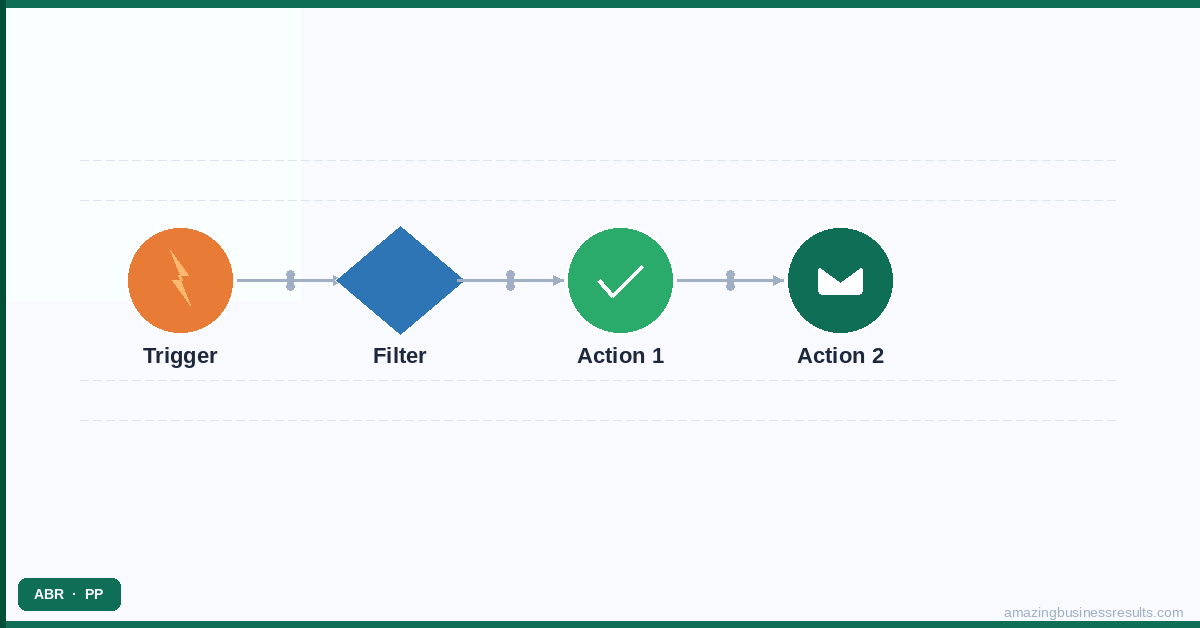
How AI Automation Differs From Standard Automation
The distinction is worth being precise about because it determines where AI adds value and where standard workflow automation is the better choice.
The practical implication: for most SMBs, standard automation should be implemented first and AI automation layered on top once the data infrastructure is in place. Zia AI in Zoho CRM becomes more accurate as your CRM accumulates more conversion data — the first three months of predictions are directionally useful, and by months six to twelve they are consistently reliable.
| Characteristic | Standard Automation | AI Automation |
|---|---|---|
| Decision logic | Rules you define explicitly (if X, then Y) | Patterns learned from historical data |
| Adaptability | Fixed — changes only when you edit the rule | Improves over time as more data is processed |
| Best for | Consistent, predictable processes with clear conditions | Variable situations where outcomes depend on multiple signals |
| Data requirement | Works immediately on any process you can define | Requires historical data to train on before predictions are reliable |
| Setup complexity | Lower — configure rules through a UI | Higher — requires data quality and volume before AI produces value |
| SMB example | When deal advances to Proposal Sent, create follow-up task | When a lead arrives, predict conversion likelihood based on historical patterns |
Where AI Automation Adds the Most Value for SMBs
Lead and Deal Prioritisation
The highest-ROI AI automation for most sales-driven SMBs is intelligent prioritisation of the sales pipeline. A rep managing 50 open leads does not have time to apply the same attention to all 50. AI lead scoring analyses every signal available — company characteristics, engagement history, similar profiles from historical conversions — and ranks leads by conversion likelihood. The rep calls the top ten first. Contact rates and conversion rates both improve because the highest-probability leads receive the most timely attention.
Zoho Zia implements this in Zoho CRM automatically once enabled. No custom configuration of the scoring model is required — Zia builds its model from the patterns already in your CRM data. See the Zoho Zia AI features guide.
Sales Forecasting and Revenue Prediction
Standard pipeline forecasting multiplies deal values by stage probability percentages — a calculation that is accurate only if the stage probabilities are correctly calibrated and all deals in the pipeline reflect their true status. AI forecasting goes further: it analyses the specific characteristics of each deal (deal age, activity volume, engagement patterns, deal size relative to historical averages) to predict which deals will actually close in the current period, not just which ones are in an advanced stage.
The practical result for management is a more honest forecast. A pipeline report showing $500,000 in Q3 expected revenue might represent $320,000 in AI-predicted actual closes — because Zia has identified that 36% of the pipeline contains deals with characteristics that historically have not closed in the stated timeframe. That is more actionable information than a straight probability calculation.
Email and Communication Intelligence
AI tools can analyse outgoing emails to suggest improvements in tone, clarity and persuasiveness — and analyse incoming emails to detect sentiment, priority and intent. Zoho Zia’s email sentiment analysis flags negative or urgent incoming emails for immediate rep attention, so high-priority messages are not lost in an inbox. AI writing assistants can generate reply drafts from an email thread in seconds, which the rep edits and personalises before sending.
For email marketing, Zoho Campaigns’ AI engine analyses historical open rate data to suggest optimal send times per contact, generate subject line options ranked by predicted open rate and identify contacts showing unsubscribe risk before they disengage.
Anomaly Detection and Risk Alerting
AI monitoring of business data surfaces problems before they become visible in monthly reports. Zia anomaly detection identifies: a rep whose deal velocity has dropped significantly in the last two weeks (possible performance issue or personal situation), a stage where deals are stalling more than usual (process bottleneck or competitive pressure), an unusual drop in new lead volume from a specific source (possible tracking issue or campaign problem). Each anomaly generates an alert to the relevant manager for investigation.
How ABR Implements AI Automation for SMB Clients
ABR’s AI automation implementation follows a four-phase process that ensures AI tools are adopted on a foundation of clean, reliable data rather than added to a system with data quality problems that the AI then amplifies:
- Data audit — before any AI tool is enabled, ABR reviews the quality and completeness of the data in the relevant system. Zia predictions are only as good as the data they are trained on. A CRM with inconsistent lead source data, missing activity logs and inaccurate stage updates will produce unreliable AI predictions.
- Foundation automation — standard workflow automation is configured first: lead assignment rules, follow-up cadences, stage-based task creation. This creates the consistent data flow that AI tools need to learn from.
- AI tool activation — AI features are enabled once the data foundation is clean and consistent. Zia is activated in Zoho CRM. Analytics AI is configured to monitor the relevant data streams. Initial predictions are reviewed against known outcomes to validate accuracy.
- Optimisation and expansion — after 60–90 days of AI-assisted operations, ABR reviews prediction accuracy, identifies the highest-value AI applications to add next and updates the implementation based on what the data has revealed about the specific business.
AI Automation Readiness: Is Your Business Ready?
Three questions indicate whether a business is ready to benefit from AI automation:
- Is your data consistent? AI learns from patterns. Inconsistent data produces unreliable predictions. If your CRM has incomplete fields, irregular activity logging and inconsistent stage progression, fix those problems before enabling AI.
- Do you have enough historical data? AI tools need historical examples to learn from. Lead scoring requires historical lead-to-conversion data. Sales forecasting requires historical pipeline-to-close data. A business with fewer than six months of consistent CRM data will see limited AI value in the first deployment.
- Is your team ready to act on AI recommendations? AI tools that surface predictions nobody acts on deliver no value. Before deploying lead scoring, establish the workflow for how reps will use the scores in their daily prioritisation. Before deploying anomaly detection, establish who reviews alerts and what the escalation process is.
Or see the full range of ABR AI consulting services for implementation support.
Frequently Asked Questions
What is AI business automation?
How is AI automation different from standard workflow automation?
What AI automation features does Zoho CRM include?
Can AI automation be added to existing Zoho CRM workflows?
Can ABR implement AI automation in our business systems?