Business Automation: The Complete Strategy Guide for Small Business
Every hour your team spends on manual, repetitive tasks is an hour not spent growing your business. Business automation replaces those manual steps with intelligent systems — so your team can focus on work that actually moves the needle. This guide covers everything: what to automate first, which tools to use and how to build a system that handles the repetitive work for you. It is the framework ABR has used to help more than 200 SMBs across North America and the UK build automation systems that save real time and generate measurable returns.
What Is Business Automation? (And What It Is Not)
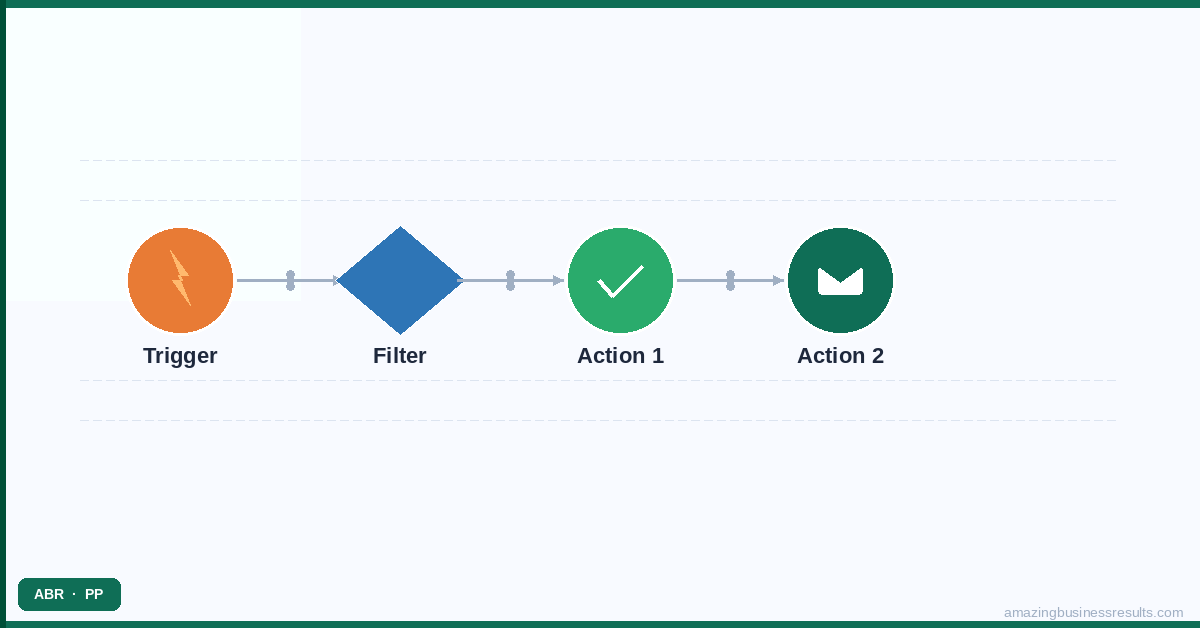
Business automation is using technology to execute recurring tasks and processes without manual intervention. When a lead fills in a form on your website, automation can assign that lead to a rep, send a welcome email, create a follow-up task and score the lead — all within two minutes of submission, without anyone touching a keyboard.
Automation does not replace your team. It removes the friction from their work — the copy-pasting, the manual reminders, the re-entering of data across disconnected systems — so they can spend time on the higher-value activities that actually require human judgment.
The 4 Types of Business Automation
Every business needs four types of automation, and most SMBs have only one or two:
- Sales and CRM automation — lead capture, qualification, follow-up sequences, pipeline management and deal close processes. This is typically the highest-ROI automation for businesses with active sales teams.
- Marketing automation — campaign management, email sequences, lead nurturing, tracking and attribution. Marketing automation turns a one-time campaign into an always-on audience engagement system.
- Operational automation — invoicing, approvals, reporting, document generation, HR processes and customer support routing. Operational automation reduces the administrative overhead that consumes management time.
- AI-powered automation — smart decisions, predictions and recommendations that go beyond rule-based automation. AI automation adapts to patterns in your data and improves over time.
The three automation clusters on this site map directly to these four types. See the relevant cluster for each:
The ABR Automation Framework: Start Here, Scale Later
The most common mistake SMBs make with automation is starting with the wrong process. They automate a low-frequency, low-effort task that saves 15 minutes per month — while their highest-cost manual process keeps running on spreadsheets and emails. The ABR Automation Framework prevents that by applying a consistent prioritisation logic before any automation is built.
| Step 1: AUDIT Map every repetitive task. Time it. Rank by frequency × cost. | Step 2: PRIORITISE Start with the highest-ROI process. Usually: lead follow-up or invoicing. | Step 3: CONNECT Choose tools that work together. Isolated automation creates new silos. | Step 4: OPTIMISE Measure, review, improve. Automation is not set-and-forget. |
|---|
Step 1: Audit Your Manual Processes
Spend one hour listing every recurring manual task your team performs. For each task, estimate: how often it happens per week and how many minutes it takes each time. Multiply these two numbers to get a weekly time cost. The tasks with the highest weekly time cost are your automation candidates.
The processes that appear at the top of almost every ABR client audit: lead follow-up (average 2–3 hours per rep per week), manual data entry between systems, invoice creation and payment chasing, report building from spreadsheets, and appointment reminders and confirmations.
Step 2: Prioritise by Return
From your audit list, identify the top three processes where automation would have the highest impact. The ranking criteria: frequency × time cost × consistency of the process. A process that happens 50 times a day and is always the same is a much better automation candidate than a complex process that happens twice a month and has many exceptions.
Most ABR clients find that automating their lead follow-up and nurturing process is the single highest-ROI automation they can build. A lead that receives an automated response within five minutes is eight to ten times more likely to be contacted than a lead that waits an hour. Automating that response requires no ongoing effort once built.
Step 3: Connect Your Tools
Automation only works when your tools can communicate. An automated workflow that sends a lead from your website into your CRM, creates a follow-up task, triggers a welcome email and scores the lead based on the form answers requires four systems to work together. If those four systems are disconnected, you need middleware to bridge them — which adds cost and complexity.
The most resilient automation stack for SMBs is one built on a single platform with native integrations across all business functions — rather than four best-of-breed tools connected by a third-party integration layer. We cover the tool recommendation in section 4.
Step 4: Optimise Based on Data
Automation is not set-and-forget. The first version of any automation workflow will have imperfect conditions, edge cases your team did not anticipate and actions that produce the wrong result in certain situations. Review every automation workflow monthly in the first quarter: check execution logs for failed triggers, review outputs for unexpected results and adjust the logic based on what you observe.
The businesses that get the most value from automation are the ones that treat it as an ongoing system — regularly reviewing, iterating and extending their automation coverage as their processes evolve.
Why We Use Zoho One to Power Business Automation
Most SMBs that approach automation for the first time end up with a collection of disconnected tools — a CRM here, an email marketing tool there, accounting software that does not talk to either of them. The automation between these tools requires middleware (Zapier, Make) that adds monthly cost per connection, breaks when APIs change and creates a fragile architecture that your team has to maintain.
Zoho One gives you CRM, accounting, marketing, HR, projects, analytics and customer support in a single platform with native automation connections across all of them. One platform means one data model, one user management system and automation that can flow across every business function without middleware.
As a certified Zoho Premium Partner, ABR implements Zoho One automation for SMBs across North America and the UK. Our experience across 200+ implementations means we know which Zoho automation configurations work in practice — not just in theory.
The Zoho Automation Stack
For the complete Zoho One ecosystem overview, see the Zoho One ecosystem guide.
| Business Function | Zoho Tool | What It Automates |
|---|---|---|
| CRM and Sales | Zoho CRM | Lead capture, scoring, assignment, follow-up, pipeline stages, deal close |
| Marketing | Zoho Campaigns + SalesIQ | Email sequences, lead nurturing, website tracking, campaign attribution |
| Finance and Operations | Zoho Books + Sign | Invoice creation, payment reminders, contract approval, e-signature |
| Projects and Delivery | Zoho Projects + Flow | Task creation, approval workflows, deadline tracking, cross-app automation |
| AI and Intelligence | Zoho Zia + Analytics | Predictive scoring, anomaly detection, forecasting, pattern recognition |
The Three Automation Areas ABR Specialises In
CRM and Sales Process Automation
Automating the sales process means no lead falls through the cracks, no follow-up is forgotten and no rep wastes time on admin that a workflow can handle. From automated lead assignment within minutes of arrival to cadence sequences that run for 14 days without human input, CRM automation produces measurable improvements in contact rate, pipeline velocity and close rate.
The CRM and sales automation hub covers the full sales automation strategy — the five stages of an automated sales process and how to implement each one.
Business Process Automation
Beyond the sales team, most SMBs have dozens of manual processes that consume management and staff time without adding strategic value. Invoice creation, employee onboarding, approval workflows, report generation, campaign tracking and customer support routing are all candidates for automation that frees your team for higher-value work.
The business process automation hub covers the prioritisation framework, the tools and the specific processes most worth automating first.
Intelligent Workflows and AI Automation
Standard automation follows rules you set. Intelligent automation learns from your data — predicting which leads will convert, identifying deals at risk before they stall, suggesting the best time to reach out to a specific contact. AI-powered automation improves over time as more data flows through your system.
The intelligent workflows and AI automation hub covers how AI is changing business automation and how SMBs can adopt it practically and safely today.
Automation in Action: Real SMB Results
Here is what properly configured business automation produces for ABR clients in practice:
- Professional services firm — automated proposal generation saves six hours of partner time per week. Proposals that previously took four hours to produce now take 20 minutes.
- Real estate agency — automated lead assignment and 14-day follow-up cadences double the contact rate on inbound leads. No leads sit uncontacted for more than five minutes.
- Healthcare practice — automated appointment reminders reduce no-shows by 30%, recovering the equivalent of two appointment slots per day across the practice.
For more detail on these and other results, see the ABR client case studies.
Frequently Asked Questions
Business automation is using technology to execute recurring business tasks and processes without manual intervention. Automation can be simple (a workflow rule that sends an email when a condition is met) or complex (an AI-powered system that predicts which leads to prioritise and automatically adjusts outreach based on engagement data).
Where should I start with automating my business?
Start with the process that has the highest weekly time cost in your business — the task your team does most frequently that takes the most time. For most SMBs, that is lead follow-up or invoice processing. The ABR Automation Framework (Audit, Prioritise, Connect, Optimise) gives you a structured method for identifying and ranking your automation opportunities.
Can I automate my business without coding?
Yes. Modern business automation tools — including Zoho CRM’s workflow rules, blueprints and cadences — are entirely no-code. You configure automation through visual interfaces, condition builders and action selectors. No programming is required for the vast majority of SMB automation use cases. See our no-code automation guide for a full walkthrough.
What is the ROI of business automation?
The ROI of business automation depends on which processes you automate and the hourly cost of the team members currently performing those tasks. A typical ABR implementation for a 10-person team saves 30–50 hours per week across the business — at an average fully-loaded cost of $50/hour, that is $78,000–$130,000 per year in time savings alone, before any revenue uplift. See the business automation ROI guide for a full calculation framework.
What is the best business automation software for small business?
For SMBs that need automation across CRM, marketing, finance and operations, Zoho One delivers the strongest combination of capability and value — a single platform with native automation across all business functions at a per-user cost significantly below comparable enterprise platforms. For businesses with simpler needs focused on a single function, standalone tools may be appropriate. ABR recommends Zoho One for businesses that want a long-term, expandable automation platform.
What is AI automation and how is it different?
Standard automation follows fixed rules — if condition X, then action Y. AI automation goes further: it learns patterns from your historical data, predicts outcomes and adapts its behaviour based on what it learns. In practice for SMBs, this means tools like Zoho Zia that can predict which leads are most likely to convert, identify deals at risk before they stall and suggest the best time to contact a specific prospect. See the intelligent workflows and AI automation guide for a full explanation.
Do I need a consultant to automate my business?
Simple automation — connecting a web form to a CRM, setting up a welcome email, creating a basic follow-up reminder — can be configured without a consultant. Where a consultant adds significant value is in automation strategy (identifying the right processes to automate and in what order), complex workflow design (multi-condition logic, cross-platform connections, error handling) and ongoing optimisation. ABR offers a free automation audit for SMBs who want to understand where their highest-ROI automation opportunities are before committing to any implementation work. Visit the Zoho consulting services page for details.
What processes are easiest to automate first?
The easiest processes to automate first are high-frequency, low-complexity and rule-based. The top five for most SMBs: lead assignment (automatically route new leads to the right rep), email follow-up sequences (send a defined sequence to new leads or contacts), invoice reminders (automatically send payment reminders at defined intervals), meeting confirmations (send automatic reminders before scheduled meetings) and report scheduling (automatically email reports on a fixed schedule).
How long does it take to automate a business process?
A simple automation — a workflow rule that sends an email when a record changes — takes 15 to 30 minutes to configure. A complete sales automation build covering lead capture, assignment, qualification, nurturing and pipeline automation typically takes four to six weeks of dedicated implementation time. A full business automation deployment across CRM, marketing and operations typically runs eight to twelve weeks.
Ready to Automate Your Business?
Or explore our Zoho consulting services to see the full range of implementation services ABR offers.