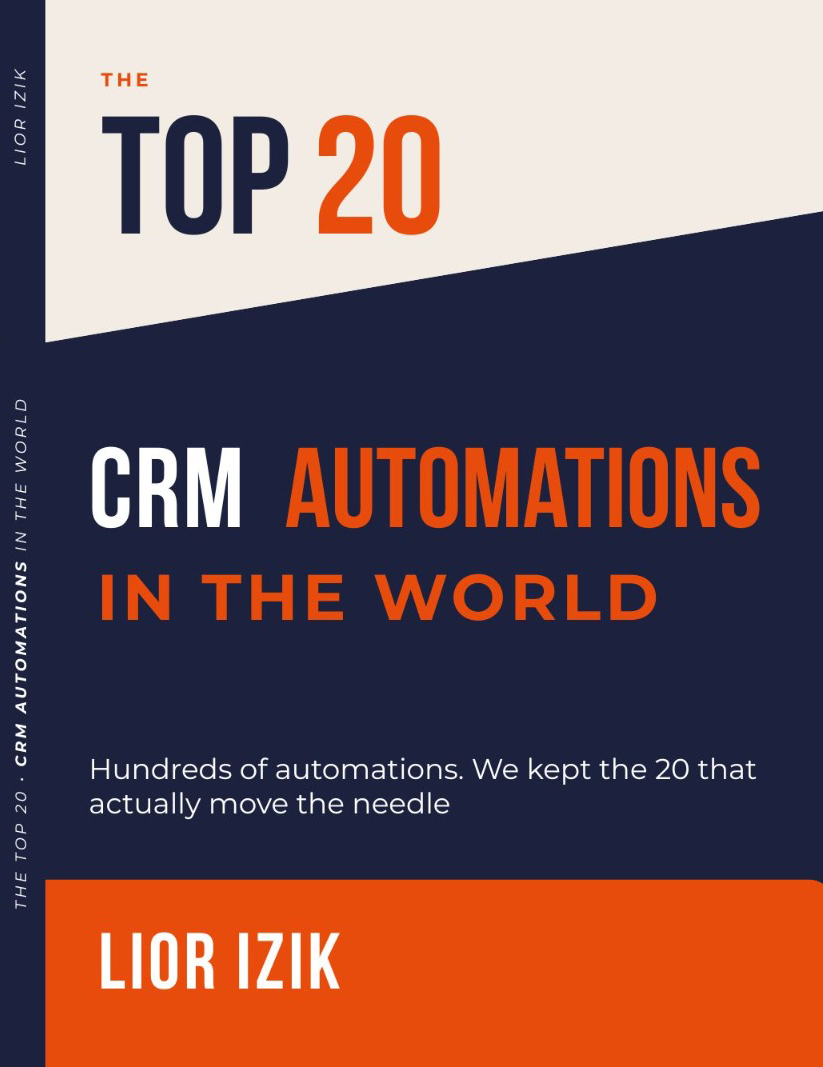
For years, the most powerful CRM automations have lived inside enterprise organizations with large IT departments and seven-figure software budgets. This book opens that playbook, twenty automations that eliminate manual work, create consistent processes, reduce errors, and give small and mid-size businesses a structural competitive advantage that was never accessible to them before.
“Lorem ipsum dolor sit amet, consectetur adipiscing elit, sed do eiusmod tempor incididunt”
“Exercitation ullamco laboris nisi ut aliquip ex ea commodo consequat. Duis aute irure dolor in.”
I genuinely enjoyed reading this book from beginning to end. What makes it stand out is the balance between real-world operational experience and a very structured methodology around automation and CRM architecture. The book doesn’t dismiss theory, but rather grounds it in practical business reality, showing how systems behave when real people, pressure, growth, and operational complexity enter the picture.
What I particularly appreciated was the progressive approach throughout the book: starting from common ‘basic’ automation patterns seen across the market, then evolving them into deeper, business-oriented architectures that actually solve root problems instead of surface symptoms. The framework around the different levels of complexity and maturity makes the content very accessible, whether for SMB owners just starting their automation journey or more advanced organizations looking to build truly scalable systems.
The storytelling is also extremely effective. The examples feel authentic, relatable, and clearly come from hands-on experience across real implementations. Rather than focusing purely on technology, the book consistently brings the discussion back to business outcomes, operational clarity, accountability, customer experience, and long-term scalability.
Overall, this is one of the most practical and business-focused books I’ve read on CRM automation and operational systems, and it does an excellent job illustrating the depth and flexibility of the Zoho ecosystem.
Thanks Lior
“When Excellence Stops Being Optional…
What I appreciated most about this book is how accessible and practical it is. The writing style is clear, engaging, and extremely user-friendly - it reminds me of the same approachable style that made your previous book (“The Entrepreneurial Evolution: Bottom-Line Lessons To Bring Your Business Into The New Age”) so impactful. This book feels less like a business guide and more like a captivating story.
The analogy of a “country made of islands” is one of the best descriptions I’ve seen for the reality many entrepreneurs and small businesses face when it comes to technology and CRM systems.
Small businesses today are overwhelmed by disconnected tools and fragmented systems. Enterprise CRMs are often too expensive, too complex, or simply not designed around the practical realities of entrepreneurs trying to run lean, efficient businesses. As a result, business owners end up signing up for multiple platforms that do not communicate effectively with one another.
That fragmentation creates inefficiency everywhere:
When systems don’t speak to each other, businesses end up operating with incomplete or inaccurate information. Messaging becomes inconsistent, reporting becomes misleading, and decision-making suffers. Without a clear operational picture, every issue starts feeling urgent because there is no centralized source of truth.
What makes this book so valuable is that it helps entrepreneurs simplify that complexity. Rather than overwhelming the reader, Lior breaks the problem down into manageable components and shows how thoughtful systems, practical automation, and connected workflows can dramatically improve operational clarity and efficiency.
This book is not just about software or CRM systems - it is about helping entrepreneurs regain control of their businesses through better structure, visibility, and automation.
For any entrepreneur struggling with disconnected systems, operational inefficiencies, or being technologically overwhelmed, this is an incredibly valuable read.”
Reading this book was a refreshing experience. It takes a topic that is often overly technical and intimidating—automation—and brings it down to earth in a way that feels natural and easy to understand.
The author does an excellent job of humanizing technology deployment, reminding readers that behind every system or process are real people and real decisions. What stood out most is how simple and relatable the content is. The ideas reflect what feels like Ivy League-level thinking, yet they are communicated in plain, straightforward language. There is no unnecessary complexity—just clear, thoughtful insights that anyone can follow and apply.
The structure of the book is logical and easy to follow, making it accessible even for those who may not have a technical background. Each concept builds naturally on the last, helping the reader gain confidence as they move through the material. Perhaps the biggest value of this book is how it makes automation decisions feel manageable. It cuts through the noise and provides clarity, helping readers think through their choices without feeling overwhelmed. Whether you are just starting to explore automation or are already deep into it, the guidance is practical and immediately useful. This is truly a must-read before making any decision on automation. It offers not just knowledge, but perspective—and does so in a way that is both insightful and easy to relate to.
Every manual task your team repeats is a process waiting to be systematized, and an advantage quietly being handed to
someone who already did.
Speed is a competitive weapon. While your team is checking emails and updating spreadsheets, an automated competitor has already followed up, scored the lead, and moved it forward.
Manual data entry, manual follow-ups, manual stage updates. Every human touchpoint is a place where things get forgotten, misrecorded, or simply never done.
When skilled salespeople spend their day on admin, scheduling, and data cleanup, you’re paying for expertise and getting clerical output.
So every rep runs their own game. Without stage-based playbooks and automated prompts, performance depends entirely on individual habit. The best rep leaves and the process leaves with them.
Nurture sequences, renewal touchpoints, winback campaigns these should run automatically. Instead they happen whenever someone remembers, which means they mostly don’t happen.
A business that runs on individual heroics has a ceiling. Growth requires processes that replicate themselves not people stretched thinner.
Get the book and discover the top 20 automations that actually work in the real world.
“What we found was that most of what practitioners were building was surface-level. The deep architecture, the kind that actually drives enterprise performance nobody was sharing it with small businesses. So we did.”
At the start of 2025, Lior set out to research what automation specialists, CRM implementers, and business consultants were actually building on platforms like Salesforce, HubSpot, Zoho, and Microsoft Dynamics. He wanted to benchmark against the best work in the market to see what the top practitioners were deploying for their clients and whether it matched what his team was building.
What he found surprised him. Almost everything was surface-level. The sophisticated automations powering top-performing businesses weren’t being documented or made accessible to smaller companies, they were locked inside enterprise deployments, built by large internal teams, and never shared.
So Lior’s team took those architectures, pressure-tested them across hundreds of real client implementations, and rebuilt them for businesses without enterprise budgets or IT departments. This book is the result, the first time these automations have been fully documented and made available to small and mid-size businesses.
“Lorem ipsum dolor sit amet, consectetur adipiscing elit, sed do eiusmod tempor incididunt”
“Ut enim ad minima veniam, quis nostrum exercitationem ullam corporis suscipit laboriosam, nisi ut aliquid ex”
I've real a lot of books on business. Almost all deal with the philosophical. Anecdotes. While this plays a part in this book Lior wrote, he ties these ideas and lessons into real work; actionable steps you can take, and shows us how to take them, in a way that insights a fire in my entrepreneurial spirit. I now have a longer list of immediate next steps than I've ever had since starting off.
I have been a client of Amazing Business Results for almost 2 years, finding them and Zoho simultaneously after we failed at two prior CRM attempts . Im not sure if Zoho was the key, or if it was just the way Lior and his team showed us how to use it.. but we've tripled our sales team and revenue, while finally making profit of note. In short, I hope my competitors dont find this book!
The modern enterprise is no longer defined by the tools or software it possesses, but by how it masters the art of leveraging data and workflows in the tools to meet its unique business requirements.
I recently (in 2025) had the pleasure of participating in a webinar hosted by Lior, where we explored the complexities of digital transformation and AI. It was immediately clear to me that he possesses a rare ability to bridge the gap between technical tools and actual business outcomes. This book is a testament to that ability.
For IT and business leaders, this book, driven by Lior's experiences, will serve as a guide for building practical, automated systems that scale. It moves beyond the "how-to" and addresses the "why," making it a valuable asset for anyone in an organisation.
I wish all readers of this book tremendous success in automating their CRM and tech stack efficiently to drive meaningful business impact. Good luck, Lior.
I've worked with many developers over the years and built more systems than I can count. What stayed with me is that technology is rarely the hard part. Communication is. Most developers build the software and expect the business to bend around it.
Lior's book is built on a different belief — that a real system should understand the business the way a good team member does, and that the developer's role is to be a partner in the process, not just a builder.
It made automation feel simple without making it shallow, and gave me ideas for what to build next as well as ways to sharpen what I already have running. That perspective is rare, and it's what makes this book worth your time.
Every automation in this book is taken directly from real implementations documented chapter by chapter, with the exact CRM workflows and AI layers used in each one. The CRM handles the process. The AI handles the intelligence. Together they do what neither can do alone.
Get the book and discover the top 20 automations that actually work in the real world.
Most business owners think their CRM problem is a sales problem. Most accountants think their reporting problem is a software problem. After years of implementing finance systems alongside CRM platforms for SMBs, I can tell you they are both wrong, the real problem is almost always a workflow problem.
Lior understands this better than anyone I have worked with. When we partnered with Amazing Business Results to build automation into our own operations at SFIR, the results weren't just efficiency gains, they changed how we think about the business entirely.
This book captures that thinking in a way that is practical, honest, and immediately applicable. Whether you are running a consulting firm, a product business, or anything in between, the gap between your data and your decisions is costing you more than you realize. This book is how you close it.
Having a peanut butter and jelly sandwich without the P or the J simply doesn’t work. Some combinations are just meant to be—and their value becomes even clearer over time, far beyond our childhood memories. The same is true for CRM systems and business logic.
In his book, Lior brings this connection to life with clarity and precision. He guides the reader through the different stages of a business, skillfully linking each phase to the relevant CRM processes on one hand, and to the real business challenges on the other. I’ve always seen myself as more of a technical professional. But working as a CRM admin and developer has taught me that understanding the business side isn’t optional—it’s essential.
Lior’s book serves as the cheat sheet for bridging that gap. If you want to make sure your “P” always aligns with your “J,” this is the guide book you need.
“Seventy-two percent of the forecasted revenue vanished. Those deals didn’t die during the nine-month validation process. They had died years before. The only thing that changed was that the company finally stopped allowing them to hide.”
From a playbook previously reserved for the world’s top businesses —
now documented for the first time.
“Neque porro quisquam est, qui dolorem ipsum quia dolor sit amet, consectetur, adipisci velit, sed quia ”
“Exercitation ullamco laboris nisi ut aliquip ex ea commodo consequat. Duis aute irure dolor in.”
Each automation in this book addresses a specific place where manual work is costing you speed, accuracy, or competitive ground — and shows you exactly how to close it.
The book dedicates full chapters to identifying every place in your revenue cycle where humans are doing what a system should do, and shows you precisely how to automate it.
Chapters 6 and 15 cover stage-based deal playbooks and implementation playbooks so your process doesn’t live in one person’s head, it runs automatically across the team.
Automations 4, 5, 10, and 11 cover the full engagement cycle, first follow-up, lead nurture, renewals, and winback, all running without anyone having to remember.
The book shows how automating the minor frees your team for the major. When admin runs itself, your best people are finally doing what you’re actually paying them for.
Manual processes create manual mistakes. Each chapter shows how the automated version produces faster, more consistent, more accurate results than the human equivalent.
These automations are documented here for the first time for small and mid-size businesses. The book gives you the architecture that top companies protect internally without the enterprise budget to match.
Founder, Amazing Business Results, Premium Zoho Partner
#1
Zoho Partner by★★★★ Reviews
30+
SpecialistsWorldwide
Since
2013
Lior’s path into business automation didn’t start with a plan. It started with frustration. Running an appliance repair company, he hired seven different CRM providers over two years trying to get a working system. Nothing stuck. So he sat down, learned the platform himself, and built something that worked in two weeks. That experience of seeing how the right system could transform a business changed everything.
It also wasn’t his first lesson in finding his own way. Growing up with dyslexia and ADHD, Lior discovered early that the traditional path wasn’t going to work for him. He found his footing in business instead starting with something as simple as buying and selling bagels as a kid, and never really stopping. That same instinct for practical problem-solving and building systems that actually work in the real world is what shaped Amazing Business Results.
What began as one person helping other business owners fix their CRM grew, during COVID, into a global team of over 30 specialists across the US, Canada, and Europe. Today the company is a premium Zoho partner, holding more five-star reviews than any other in the ecosystem. The philosophy has never changed: think like a business owner first. Build systems that support people, not exhaust them.
#1
Zoho Partner by★★★★ Reviews
30+
SpecialistsWorldwide
Since
2013
Get the book and discover the top 20 automations that actually work in the real world.